Lausanne-based director Marie Eve Hildbrand’s debut feature documentary Healers (Les Guérisseurs) is both a family affair and a wide-ranging meditation on different approaches to (and philosophies about) healthcare.
One of the film’s main subjects is the filmmaker’s own father, Dr Hildbrand, now in his 70s and who has a small, long established medical practice he runs on his own. He is an old-fashioned doctor, the kindly, patient type who always listens carefully to his patients. He is at the end of his career but the film also features medical students who are starting their long journey to becoming fully qualified doctors.
Alongside these healthcare professionals, the director considers alternative medicine, speaking to shamans and faith healers. Meanwhile, as a complete contrast to the quiet humanism of Dr Hildbrand, the film shows new medical technology in the shape of talking robots which use AI to diagnose and treat illnesses.
“When I do a film, I do a movie with the characters and not on the characters,” filmmaker Hildbrand (who was voice director on Oscar-nominated Swiss animated feature My Life As A Courgette) says of her approach.
Just as her father always has time for her patients, the director is equally attentive to her subjects. She likens the actual process of filming to “a ritual,” something over which she always takes great care. Hildbrand was shooting with a tiny crew and tried to be as sensitive as possible when setting up her camera in the surgery. The crew stayed in the doctor’s waiting room and she asked all the patients whether they were comfortable being filmed during their consultation. “Of course, sometimes it was ‘yes’ and sometimes it was ‘no.’”
Healers opens with flickering archive footage from the early days of cinema, depicting what appears to be a man in a white coat. “I don’t know very well the story of cinema but I think it starts with scientists and doctors who wanted to understand why we move and how we move,” Hildbrand explains this choice. The history of science and medicine, and that of cinema, are, she suggests, intertwined.
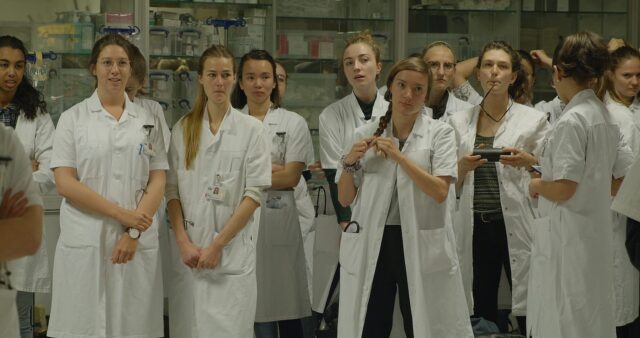
The students are captured learning about everything from dissection to how to speak to patients – and we see them taking possession of their stethoscopes for the very first time. They were from Lausanne, close to where the director lives. (She describes this as a “very local” movie).
“I wanted to speak about different [approaches to] medicine, not only the one we know,” Hildebrand explains some of the stranger moments in the documentary. For example, we see an alternative healer spraying incense, then placing an egg in the circle of an iron key. Her patient, one of the medical students, is invited to close her eyes and blow on to the egg. She is told that she can thereby get rid of all of her negative feelings. At the end of the process, she smashes the egg and throws it in the garbage.
It might all seem like mumbo-jumbo but the documentary is exploring the power of thought in medicine – the idea that even the most outlandish cures can work if you believe in them fervently enough. The director points out that “some things are not – yet – proven and perhaps never will be, since they are not measurable,” but that doesn’t make them irrelevant.
There was an unpleasant surprise during the shooting of the documentary when Dr Hildbrand, who had been close to retiring, had a heart attack. “It was really a bad coincidence,” his daughter says of this distressing and unexpected event. “He is 79 years old. He was really, really tired…of course, it was very stressful. I didn’t want to [continue to] film at first.”
Thankfully, the doctor recovered. He had hoped that he could find a younger colleague to take over his practice – but no-one was willing to step into his shoes. In the end, he had to close down the surgery. “Of course, it is the story of my father but it is also the story of a chapter of medicine which is ending with him,” the director says of the changing approaches of doctors who are no longer willing to follow Dr Hildbrand’s example and to work on their own.
Hildbrand, who edited her film during the pandemic, remains sceptical about the medical benefits of robots and artificial intelligence. These robots, she points out, don’t have the same feeling for patients as flesh and blood doctors. “It looks like empathy but, of course, it is not,” she says of their interactions with humans. “I know many people who feel good with robots…but I think that when we meet another person, we learn more things about ourselves.”
Healers has been chosen to open Visions Du Reél. Although there is a physical screening, because of Covid restrictions this won’t be a full red carpet premiere. That’s a disappointment for Hildbrand but she believes the pandemic has given her a film a new resonance. “With the pandemic, everybody feels vulnerability,” she suggests.
Her film, she continues, shows that there have always been two vital elements to medicine, wherever and however it is practiced: savoir faire and savoir être – that’s to say, both expertise and human sympathy.
The film was produced through Bande à Part Films, who also handle international sales.