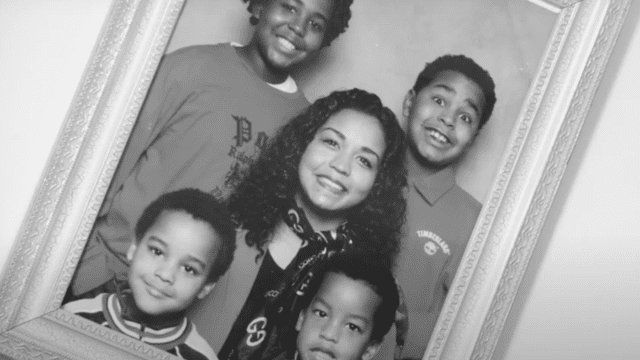
Time addresses racism and the cruelty of the US penal system but it does so in a very personal and poetic fashion, told from the perspective of a resilient woman holding her family together as she campaigns for her husband’s release from prison. Director Garrett Bradley describes the evolution of the project to Business Doc Europe.
Fox Rich is a wife and mother who has spent over 20 years campaigning for the release of her husband, Robert, given a 60-year jail sentence for a bungled bank robbery in which she also participated. (Rich was released after three and a half years).
It is a raw and intimate film about the experiences of a particular woman, her children and her husband. It is also, as Bradley puts it, “the story of 2.3 million American women and their families.” The premise may be bleak but the doc was intended to be hopeful – to celebrate Rich’s “daily resilience and resistance.”
Shot in black and white, the documentary takes the perspective of Fox as she holds her family together. She is an author and motivational speaker, a resourceful and inspirational figure who still clings to her belief in the American dream. However, the depth of her suffering as she waits for her husband to come home is obvious.
Filmmaker Bradley had first met Rich when she was making her short 2017 doc, Alone, about Aloné Watts, a southern woman whose boyfriend was behind bars. She thought that Rich would make a strong subject for “a sister film,” which would have obvious thematic overlaps with Alone.
Time (which picked up the 2020 Sundance Directing Award: U.S. Documentary) makes ingenious use of Rich’s home movies. These were very late additions to the project, however, as at first Bradley didn’t know that this material existed.
“I think it was on our last day of filming. At the time, I was committed to thinking about this as another 13-minute film,” the director says of the moment Rich revealed the home movies. “I remember saying to her ‘I’ll come back in a few months and show you a cut.’ It was evening time. That meant she was on the phone with Robert. She said ‘hold on a second’ and ended up handing me this small black bag which had around 100 hours of her own personal archive in it which I wasn’t aware of at the time.”
The discovery of the material made Bradley radically re-think her doc.
“On one hand, it was your dream come true as a filmmaker, and your worst nightmare,” the director notes of the unexpected gift. The new footage was clearly going to add many extra layers to the film – but it also required huge amounts of added work. She and editor Gabe Rhodes had to overhaul the structure of the documentary. It turned into a feature, 81 minutes long. She adds, however, that the “intention” behind Time didn’t change at all. Bradley had embarked on the project because she realised “there was a true absence in talking, thinking and seeing incarceration from a woman’s point of view, from a family’s point of view.”
Ask her how Covid affected the roll-out of Time (which was picked up by Amazon after its Sundance premiere last year) and Bradley suggests it’s a perfect documentary for lockdown, a love story about isolation and enforced physical separation – something which families globally have had to endure over the last year.
When she is making a documentary, Bradley always aims to be “honest and transparent” with her subjects but not to make promises she can’t keep. Nonetheless, her bonds with Fox Rich and her family are now very strong. “We will always be in each other’s lives,” she says.
Time was screened to Rich Fox a few weeks before its Sundance premiere. “Concordia Studio [the producers] hosted a small screening with myself and Fox and Robert and some friends of theirs. We just held hands. I just remember sitting next to Fox and we were holding hands through the entire film. It was incredibly emotional for everybody, not just for her.”
Fox hadn’t seen her own home movie footage since she had shot it. Robert had never seen it. They were together, watching key moments in their kids’ lives.
Bradley cites Japanese designer Yohji Yamamoto when asked why she filmed Time in black and white. “He talks about how, when you make clothes in black and white and you’re cutting them, you can see their shape better; you can see their form in a certain kind of way. I really connect with that.” The director also talks about the tonal beauty of black and white.
The Oscar-nominated filmmaker has illustrious parents. Her mother Suzanne McClelland is a celebrated abstract artist whose work is held by many of America’s top museums. Her father Peter Bradley is also a distinguished painter and sculptor. She is still “figuring out” how their artistic practice has influenced her own work. “My father is 20 years older than my mum. They come from different generations. They are both abstract painters…if there is anything I can really say that I’ve taken from them, it is having the confidence to build a life for myself that is centred around my craft.”
For Bradley, filmmaking isn’t about wealth or prestige. “Even if I wasn’t getting paid, even if I wasn’t able to sustain myself making films, I would always be doing them,” she insists. Over the years, she has had to take her share of mundane jobs to support herself. “I didn’t start making money until that recently. But…being in the world and having jobs that are not connected to your craft is important. There’s a little bit of this pre-conceived notion that you aren’t the real thing [as an artist] unless it is the only thing you are doing. That couldn’t be further from the truth. What are you going to say about the world in your work if you are not in the world? I’ve worked in funeral homes, flower shops and at American Apparel, all sorts of jobs. They’ve been done to pay the bills but they’ve also kept me in [the] community, in a place of observation.”
In high school, she worked as an intern on Flag Wars (2003), the documentary directed by Laura Poitras and Linda Goode Bryant.
Ask about her cinematic influences and she cites everyone from documentary great Frederick Wiseman to the mystical Russian director, Andrei Tarkovsky, and the flamboyant Hong Kong auteur Wong Kar-Wai.
Bradley has a very distinctive, lyrical and personal filmmaking style but she insists there is nothing self-conscious about her approach. “I am doing the best I can. I am doing it [the filmmaking] the only way I know how, the way that is intuitive to me,” she muses. “I am just being myself actually, sharing the way I see things.”
Since winning the Sundance prize for Time back in 2020, Garrett Bradley has been working on a documentary series for Netflix about tennis superstar, Naomi Osaka.
“When you are a young person, you are constantly changing and evolving. The show will really be capturing a moment in her life,” Bradley says of the Osaka series which follows its subject (currently the world number 2) as she competes in Grand Slam tournaments and prepares for the Tokyo Olympics. “It will really be about witnessing her personal growth,” she ends.