

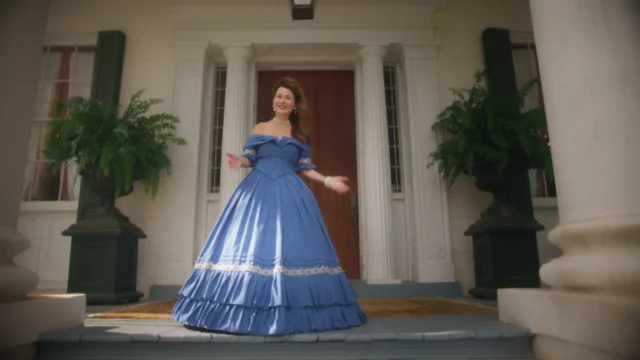
From a distance, Natchez looks like a charming, picturesque southern town in the US. Its population is relatively small, around 14,000. You’ll find plenty of ornate ‘antebellum’ houses from the days before the Civil War here. Tourists can pay for guided tours. Locals sometimes dress up in Scarlett O’Hara-like ball gowns.
But scrape away the gleaming facade, as filmmaker Suzannah Herbert does in her award-contending film Natchez (sold by Cinephil), and you quickly discover this is a place with a complicated and even tragic history. Natchez was home to the ‘Forks of the Road,’ the second largest slave market in the US.
The director describes her documentary as an “antidote” to the MGM blockbuster Gone With The Wind which, adjusted for inflation, remains one of the highest grossing movies of all time.
“It [Gone With The Wind] is extremely influential in white dominant culture in this country. It informs so much still. People are still watching it and still being impacted in how they view our history – which is problematic and not good. I think pop culture is way more influential than historical fact in the way a lot of people get history.”
Viewers of the documentary get to see inside the grand houses and to listen to their white owners (many of them members of the almost all-white Pilgrimage Garden Club) tell polished anecdotes about their ancestors and the glory days before the Civil War. However, they’re also given an alternative version of Natchez history by Rev, a Black preacher who runs his own tours of the town – and who lets visitors discover the true legacy of human exploitation on a massive scale.
Late on in the film, David, one of the white home owners, is shown on camera making openly racist remarks. He is a complex figure – and that’s the point. He’s charming and mischievous, enchanting guests with this repartee, coping bravely with his own failing health and with the homophobia some of the townsfolk direct toward him as a gay man. But he expresses some truly noxious opinions in language bound to shock many spectators.
“One thing I really wanted to do was to show everyone’s humanity and their complications. I didn’t want to paint them as one thing. That is how my experience of David was. He is charming. He is really funny. But yet he has these extremely racist and terrible views. I think that’s very insidious…he is among the community and he is powerful,” Herbert says. “For me personally, it was really hard to stand there and listen to it. But I knew that capturing the moment was part of my responsibility.”
There’s no subterfuge in the way David was filmed. The camera was right in front of him. During his rant, there are no cuts.
The film was shown to its main participants in advance of its premiere at Tribeca earlier in the year. Most gave it their blessing. At community screenings, it provoked intense debate. “I think the Black community feel seen and they’re really happy with the film. I think the Garden Club, they’re not so happy.’
When David saw the documentary, he acknowledged it was “very well put together” and thanked the filmmakers for inviting him to a screening. His husband, though, was very angry indeed, walking out before the screening had even finished.
Herbert and her team filmed for 75 days in Natchez. “We finally cracked the code when we realised we could use Rev’s tour, the history he is telling, as the structure for the film,” she explains why the preacher’s insights about the town’s past are so heavily foregrounded.
It helps that Rev is a master storyteller who knows how to makes tourists feel at ease as he drives them around town in his van before slowly revealing the “hard truths.”
“That’s what we wanted to do with the film as well, bring people in and have them trust you…”
Many other voices are heard too. Herbert took inspiration from Robert Altman’s freewheeling country music satire, Nashville (1975) in the way she pulls together a huge array of different characters and points of view.
The idea for the documentary came after Herbert was invited to a wedding on a plantation. That made her very curious about how “white people today use historic spaces and plantations for their own enjoyment and their own profit, and how complicated that is…I wanted to understand that. Do they not care about the suffering that happened there?”
Growing up in Memphis, attending racially diverse schools, the director wasn’t taught the ‘Lost Cause Mythology’ that portrayed Confederates as noble heroes. “I was definitely aware of it but it wasn’t a huge part of my upbringing.” She later learned more about this distorted account of the past through the ‘Facing History & Ourselves’ programme which encourages students to confront historical instances of racism, injustice and genocide. “That had a huge impact on my understanding of history and how that affects our lives today.”
The economic divide persists in Natchez today. The white community still holds on to most of the wealth and power – and also still controls the narrative. But this may be changing. Certain characters in the film itself are shown reassessing their views of their home town. “There is a lot of hope, and people are open to change and open to listening.”
Funding for Natchez came from ITVS, Catapult Film Fund and The Ford Foundation among other partners. Oscilloscope has US distribution rights to the film. “If we were trying to make the film today, we would not have the resources because of the cuts to public funding,” the director strikes a downbeat note about independent documentary making in the US. Nonetheless, Natchez is clearly striking a chord. It has played at festivals all over the US. Many screenings have been sold out. In Atlanta, where the film had its Oscar-qualifying run, it was one of the most popular films of the year, behind only Sinners and Wicked among audience favourites.
Although many of the subjects in the film are middle-aged or older, the documentary is attracting younger viewers. “One thing that has been cool to see is that our trailer went viral on TikTok and we have had so much engagement from young people. I think the film resonates with young people.”
These younger viewers are questioning the “incomplete” version of history that their parents are giving them. There are signs that attitudes within Natchez itself are changing.
Whatever the chequered history of the town, Herbert loves spending time there and often returns. “Natchez is wonderful. I’ve made connections and have relationships with so many people…it can be a really fun place. I encourage people to go there – and take Rev’s tour!”





