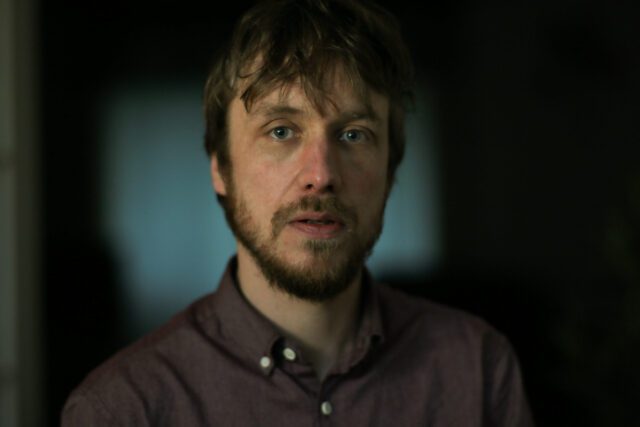
British director Toby Paton (pictured) tells Business Doc Europe about the making of his C4 doc Max Clifford: The Fall Of A Tabloid King about the publicist to the stars who died in prison in 2017 after his conviction as a sex offender.
He was the “king of kiss and tell,” the British celebrity publicist who could make and break careers. Max Clifford, who died in prison in 2017, was once among the most powerful figures in the British media. He was behind the “Freddie Starr ate my hamster” headline about the UK comedian’s rodent-crunching dietary habits that appeared on the front page of The Sun in 1986. If clients crossed him, he could use his Fleet Street connections to destroy and humiliate them.
He could also provide editors with scoops and exposés which would add huge numbers to their papers’ circulation. However, the biggest scandal in Clifford’s career was the one involving himself – and which eventually led to his 8-year jail sentence in 2012 when he was convicted as a sex offender preying on young women.
Now, British director Toby Paton has made a documentary Max Clifford: The Fall Of A Tabloid King (launched on Channel 4 earlier this month) which tells the Clifford story in all its grimmest details.
“When we first started looking at this, it was not long after the Jeffrey Epstein revelations had broken,” Paton, whose previous documentaries include The Brexit Storm (2019) and Jo Cox: Death Of An MP (2017), remembers. “The idea of powerful men who take advantage of their position to sexually exploit and abuse young women – I think that’s an issue we as a society are thinking about quite a lot at the moment.”
Clifford’s story had never been told on screen. It seemed a timely moment to tackle it.
The documentary was made through Story Films, the company set up by Peter Beard and David Nath in 2016 and whose previous credits include Losing It: Our Mental Health Emergency and The Interrogation of Tony Martin. “It was a very gradual process of trust building,” the director says of the time it took to persuade Clifford’s victims, including a woman who had been groomed and abused as a 15-year old, to talk on camera. The filmmakers made contact initially with this woman through a senior police officer involved in Operation Yewtree, the long-running British police investigation into sexual abuse allegations. “She wanted to be sure we would respect her desire to remain anonymous.”
To Paton’s relief, she admires the documentary and describes it as “empowering.” In spite of the guilty verdict against Clifford, she and other victims had long felt their story had never been told properly. All the coverage always focused on Clifford and they were treated as bystanders. “They had appeared in the public consciousness as part of Clifford’s narrative. What they found valuable about the film was that, for the first time, they felt the story had been told through their eyes and it had become their narrative.”
When the film was already in motion, Paton had a lucky break. He contacted veteran author and journalist Angela Levin, who had written Clifford’s authorised biography ‘Read All About It’. “I thought she would be an interesting person to speak to and I was fascinated to see what she made of Clifford,” the director recalls. Levin told him that she still had the audio-tapes she had made when interviewing Clifford for the book. These turned out to have some strange and surprising revelations in which the publicist talked about his own behaviour as well as the sex lives of various famous people. His remarks had been so outlandish that Levin had originally discounted them.
Before his arrest, Clifford had claimed that he had “a black box full of secrets” containing very incriminating material about many powerful public figures. This would be his protection if anything went wrong for him.
“It was an interesting question as to how much of this was reality and how much was maybe Clifford’s own fantasy,” Paton reflects. “I wonder whether maybe it was in Clifford’s interests to have people believe he had all these secrets. It was all part of generating the mystique around him, the myth of Max Clifford, the all-powerful publicist. That image really served him very well.”
For many years, Clifford was a ubiquitous presence in the UK media. He was a regular on chat shows and radio programmes. Nonetheless, when Paton tried to licence clips from the many programmes on which the publicist had appeared, there was extreme reluctance to allow the material to be used. “It was actually quite surprising because you really got the sense that these were people who didn’t want to be associated with Clifford,” Paton notes.
Now the documentary has premiered on UK TV, the filmmakers are looking to “get it shown to a wider audience internationally.” This may be a very British tale of scandal and exploitation but its themes are universal.
Asked what he hopes his film might achieve, Paton replies that the doc has “shone a light on what Clifford was really like and on the way in which so many people in Fleet Street allowed him to get away with what he got away with for as long as he did…hopefully, it has, in a fairly definitive way, reframed his story around the crimes he was convicted of. When people think of Max Clifford now, hopefully they will think of the Max Clifford you see in the film we made rather than the Max Clifford as he presented himself over 30 or 40 years of his public career.”