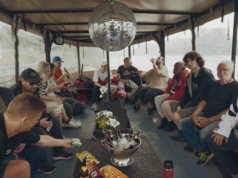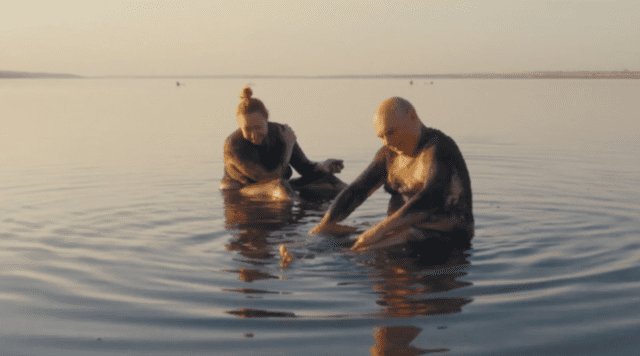
Yes, Gar O’Rourke did himself try the mud treatment when he was preparing his new feature doc Sanatorium (a world premiere in International Competition at CPH:DOX and sold by MetFilm Sales). He has also done the salt pools the electro-massages and everything else between.
The film is set in Kuyalnik, a huge Soviet era spa in Odesa in Ukraine. Guests aren’t nearly as plentiful there now as normal. The full-scale invasion of Ukraine by Russia obviously has something to do with that. Nonetheless, people are still coming for the fertility treatments or rehab from war wounds and trauma, or simply to bask like hippos in all that dark, oozy mud. The staff are working heroically to keep the place open even though the facility itself has clearly seen much better days.
Many docs have been made in Ukraine since the invasion but this is surely the gentlest, funniest and most surprising.
The Irish filmmaker first went to the sanatorium in the spring of 2021. After taking all the treatments himself, he began to think about making the film.
“More than that, it was getting to know the staff and the guests and their experiences,” O’Rourke adds. “Of course, when the Russian invasion happened, that changed everything. The sanatorium closed for at least a year before they opened again. From the staff’s perspective, they felt the Ukrainians needed this sanatorium more than ever because not only is it a place for holidays and treatment but also it is really a place for respite.”
O’Rourke portrays the protagonists in all their quirkiness but we are always aware of his affection for them. There’s the mother and her hapless son, the burly manager who likes to shout at staff but turns out to have a very big heart, and the old-timers who love to play ping pong.
The constant sound of air raid sirens reminds us that the war is not very far away.
When the sanatorium reopened in 2023, O’Rourke went straight back out there, met all the staff and guests, and continued his research. However, it wasn’t until 2024 that the financing was finally closed and the project moved forward into production. (The film is produced by Venom Films, the Dublin-based company Ken Wardrop founded with Andrew Freedman in 2006).
Even then, there were glitches. One funder pulled out for security and insurance reasons. Screen Ireland then presented the filmmaker with a choice. Either he could wait to make the film until the end of the war or he move forward immediately – but that would entail O’Rourke directing “remotely.” He chose the latter option.
The production team is entirely Ukrainian. O’Rourke was the only Irish person involved. The film was made over a period of 45 days with 35 “shoot” days.
“It was an incredibly well-planned film. We had a team of seven or eight there and it was very methodical how we approached it…we adapted really to the challenge that was put in front of us.”
It helped that O’Rourke had already made a documentary in Ukraine. His well-received 2020 short Kachalka, also produced by Venom, profiles the largest outdoor gym in the world, which is in Kyiv.
“I think they work really well as companion films. I think there is something quite uplifting about both…they are summer films. They are getting under the skin of people and a place really.”
Sanatorium has a surprising amount of comedy. O’Rourke points out that many top US comedians boast Odesa ancestry. “There is a very unique Odesa sense of humour. Definitely, Dmitri, the manager, has a bit of it. It’s something the crew were very proud of, and I am as well, that the film really does offer quite a different perspective on life in Ukraine at this time.”
There isn’t huge amounts of dialogue in the documentary. Instead, the director focuses on the looks and gestures of his subjects.
“I am a big believer in trying to communicate things in the most simple and efficient way possible. Often, particularly with observational documentary, so much of it is building the relationship with characters in advance so they can be themselves in front of camera. Then, it is really down to very selective framing to try to communicate that scene in as few shots as possible,” the director reflects.
He adds that you can learn as much from “hands, body language and the non-verbal communication” as from words. “Often what people don’t say is more revealing than what they do say.”
O’Rourke conducts lengthy interviews with his characters before shooting begins. That means he knows their daily routines and idiosyncrasies inside out. “A lot of work is done in advance of filming and then, when filming happens, it is just reacting to people’s lives.”
One ambition was to give audiences the sensation that, after watching the film, they will feel they have gone through a “little bit” of the spa treatment themselves. In other words, they’re supposed to relax and enjoy themselves.
The film features people of all ages and shapes, sometimes revealed very intimately. The director says he is “drawn to people who really accept themselves.”
“There is nothing shameful about showing people’s bodies. In Ukrainian culture, people are very open sometimes about showing themselves. They’re comfortable with who they are…it comes back to that thing that if you respect and love the people in your films, hopefully that comes through. It certainly isn’t my motive to try and make fun of anybody.”
The film’s Ukrainian premiere is likely to come in the early summer, possibly at a prominent doc festival.
O’Rourke meanwhile is already in pre-production on his next feature doc, The Siege of Paradise. Shooting on the Italian Riviera and again being made through Venom Films, this is about tourism running amok in one of the most beautiful places in the world.
As for Sanatorium, it portrays a Utopian world where all the struggles in the outside world melt away and where all the guests are on an equal footing.
“On my first visit there, I spoke to one of the ladies in charge of the hydro massages – I wouldn’t suggesting doing this because if you like your genitals, you need to be very careful when you are in these baths. But she told me something very simple and on the point: everyone gets sick – the rich, the poor, the young, the old. That’s what they have in common. They’re all there with the purpose to feel better about themselves physically, psychologically. Health is the one factor that connects all humans…”
Sanatorium is selected for the European Film Promotion (EFP) and CPH:DOX EUROPE! On Demand initiative designed to boost the visibility of European documentaries in the North American market.