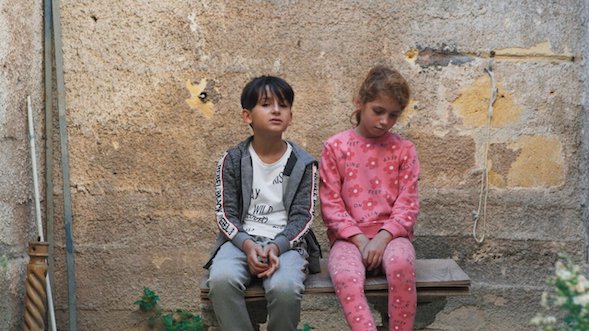
How do adults make a documentary about the private world of children without intruding into and destroying that world? This was the very delicate challenge facing filmmakers Danny Biancardi, Stefano La Rosa and Virginia Nardelli when they embarked on their project, The Castle, screening in competition at CPH:DOX (and sold by Fandango).
Their setting is an abandoned kindergarten in Danisinni, a run-down neighbourhood in Palermo, Sicily. Three 11-year old kids, Angelo, Mery, and Rosy, have taken over the place, cleaning it up and making it into their own magical refuge where they can hang out and play.
“We started the research of the film about four years ago,” says La Rosa. “We really took the time to get to know them and their families. From the very beginning, we tried just to play with them, not to impose an idea that we already had about the film the film we wanted to make but just to try to find something together with them and to make them comfortable.”
The filmmakers had met at the Centro Sperimentale di Cinematografia Foundation film school in Palermo where they were studying documentary.
Biancardi and Nardelli are not from Sicily but had moved into the neighbourhood when they enrolled at the film school. However, La Rosa (now based in Paris) is from Palermo.
Most of the film is observational but the directors orchestrated certain scenes, based on the games the kids were dreaming up. For instance, when the children become obsessed with a mirror, the filmmakers asked them to play with it on camera. Biancardi emphasises that “nothing is staged.” Even when the directors did make suggestions, the kids were still improvising and were “still in control” of their own stories.
In the film, the kids are shown gaining access to the abandoned building by slithering through a tiny gap in the fence. This isn’t some hidden house in the woods. It’s a huge facility based in the middle of the neighbourhood, and “impossible to avoid” according to Biancardi. It was still a little spooky, though, and La Rosa suggests there were times when the kids were glad to have the adults with them.
The building stood as a symbol of neglect on behalf of the local government. It had been left to rot for 15 years. One reason the kids were drawn to it was because there were so few other places where they could play.
Work on the film began in earnest in 2021. By then, the directors had finished their studies at the film school.
Nardelli explains how they gradually found the best way to tell the story through trial and error and over a 4-year period. They all took turns shooting the material and say that now they can’t remember who filmed what.
This is a tough working-class district. Some of the kids have parents in prison. “It’s a place with a lot of contrasts. You have unemployment, poverty but also this incredible energy in the people,” says La Rosa.
Little Angelo, the doe-eyed boy who is one of the film’s main protagonists, is one of the more sensitive figures. He faced taunts from his male schoolmates because he was spending so much time with the filmmakers and with his two female friends. “But one thing we liked about him [Angelo] was that he was very curious and was looking for a different way of playing and of expressing himself. He loved to talk,” Biancardi says of him.
Whereas Angelo was thoughtful and came up with surprisingly original ideas for the games, the girls Merv and Rosy were outgoing and practical. The building as they first encounter it is dirty and full of debris but they soon set to work with their brushes and cloths, sprucing the place up.
“We helped them – but not that much. We removed some heavy stuff but they did it mostly by themselves,” Nardelli says of the spring cleaning they gave to the old building. “We helped them to carry a little bit of the furniture but they decided to bring all the soaps and cleaning stuff.”
The film, which was produced through Nadège Labé at La Société du Sensible in France and Giulia Campagna and Stefano Collizzolli at ZaLab Film in Italy, is seen almost entirely from the point of view of the kids. Adults hardly feature. However, the filmmakers emphasise that the parents (who were recently shown the movie) were supportive of the film. “They were happy we were taking care of them [the kids] and helping them do nice activities,” remembers Nardelli.
“They couldn’t really understand how the film would look like. When we finally showed it to them, they realised it was something real because it was a very long process. We worked with them for two years…they were completely OK with it because it is their daily life. There is not a judgement in it,” says Biancardi.
The abandoned building is now being redeveloped and will again be a functioning kindergarten. On the one hand, that’s positive for the community. On the other, it means that the magical, self-enclosed world the kids world so hard to create for themselves has now been taken away.
It’s easy to look for a political subtext in the documentary and to see it as exposing neglect and child poverty but that is not how the directors regard it. “Of course, it could have been something really social but in the end, I think it is more a film about childhood and the fear of growing up,” La Rosa signs off.
The Castle is selected for the European Film Promotion (EFP) and CPH:DOX EUROPE! On Demand initiative designed to boost the visibility of European documentaries in the North American market.