Hurricanes begin in Cape Verde, caused by the Earth’s rotational bends and deflected trade winds. That is where Petr Lom and his producing partner Corinne van Egeraat ventured to make their new feature documentary, The Coriolis Effect, world-premiering at Movies That Matter. The film comes billed as a “meditation about our world spinning out of control.”
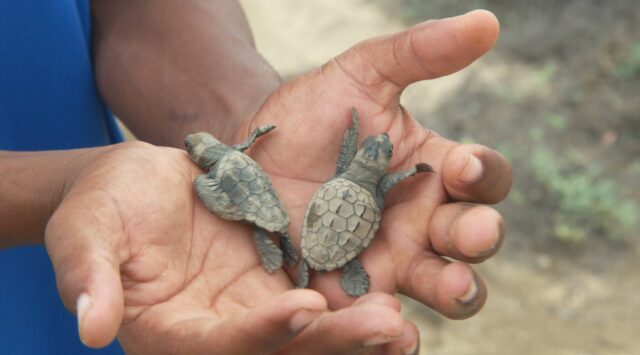
One of the most poignant images in the documentary is of a baby turtle trapped in fishing nets and garbage, washed up on shore, but trying heroically to make it back to the sea.
Lom was on his hands and knees on the sand, filming the tiny creature on its epic journey. In a way, he agrees, the turtle’s battle stands as a metaphor for the struggles that everybody else in the film faces to survive in this remote, dry, windswept place.
“There’s an old myth that the world is built on the back of a turtle; that the god came down and put a little dirt on a turtle’s back – and the world is built on that little handful of dirt,” Lom reflects. “We didn’t want to make it explicit but that is why the turtles are representative of humanity and who we are, because if the turtles go, we go.”
There is also extraordinary footage of starlings and larks in a bird sanctuary. The birds clearly have no fear of humans and will descend in their swarms whenever there is a sight of water.
What took Lom and van Egeraat to Cape Verde in the first place?
“We were travelling. We went on a holiday,” Lom explains. He and van Egeraat have been fans of Cape Verdean folk music since hearing the work of Cesária Évora. When they arrived on the islands, they fell in love with the place and immediately thought of making a film about the music scene.
“We had been interested in the subject of home, the fragility of home and the longing for home, and that is central to Cape Verdean culture and music.”
With so much poverty, many Cape Verdeans are forced to leave, but they yearn to return. “That was the initial idea, a film about the longing for home through music but then it evolved into this film about the fragility of home in general which is our planet. Then, when we learned about all the difficulties they had had there with drought, we thought that even works better as a metaphor – and above all when we learned it’s the place where hurricanes are born.”
The filmmakers became friends with Vasco Martins, a maverick poet and composer who lives in Cape Verde – and who thinks nothing of playing music in the desert as the wind swirls around him. He features prominently in the documentary, making the occasional mystical pronouncement. “Life is a pilgrimage where you realise it or not,” is one of his more memorable insights.
It’s now over seven years since Lom and van Egeraat first visited Cape Verde in 2017. The project was delayed by Covid. “But that was in a way a blessing in disguise,” Lom says now of the pandemic.
While dealing with themes of music and exile, the filmmakers had at first also intended to make the documentary more explicitly political. One idea was to look at how the US throws out Cape Verdeans and deports them back to the islands. Eventually, though, the focus was placed as much on nature as on any of the human beings. They wanted to make the story of a solitary little worm crawling across the desert seem as important as that of any of the humans in the documentary.
Another “loose metaphor” is that “we are all lost in the world; this fisherman is lost in the fog who survives, then there are these migrants are lost and then the sea turtle trying to get back to sea after it lays its eggs goes the wrong way too.”
Lom and van Egeraat were in Cape Verde when its finally began to rain after a very long-lasting drought. “We are not cheating there. It really happened the way we did it,” Lom says of the sudden deluge which causes flash flooding throughout the valley and seemed to transform the landscape instantly.
The Coriolis Effect is in a very different register to other recent films by Lom and van Egeraat dealing with the political repression and military dictatorship in Myanmar. Lom points out that their 2024 film, I Am the River, the River Is Me, exploring how Aotearoa/New Zealand’s Whanganui River was given legal rights, was another nature-themed story.
With The Coriolis Effect, Lom talks of trying to induce a sense of awe in audiences – to remind them they are “tiny and small” next to the vast forces of nature. “Maybe that’s naive but that’s really the function of the film.”
During filmmaking, the team was based on São Vicente, “the cultural island.”
“Unfortunately, during Covid, everything was shut down but outside Covid, it’s wonderful. There are tiny little music bars all over the place and so many places to just go and listen to music,” Lom says.
The project has had a lengthy gestation. Research began in 2017, and they filmed between 2019 and 2023, spending eight months in Cape Verde during the pandemic.
The documentary was produced through ZINDOC, the Amsterdam-based company Lom and van Egeraat run, together with Norwegian outfit Ten Thousand Images and EO Docs in the Netherlands.
“You always start with zero whatever film you make,” Lom says of the struggle to get new work made. He and van Egeraat have made a string of successful documentaries over the last two decades but still need to fight for funding.
Norwegian producer Mette Cheng Munthe-Kaas has co-produced several of their projects. “Particularly on this film, the partnership was really fruitful because her husband and partner Runar Jarle Wiik is the underwater cinematographer – and filming the baby turtles in the sea, that’s even harder than it is on the beach.”
Wiepko Oosterhuis,’ Bantam Film will be releasing The Coriolis Effect in the Netherlands. “These are the types films he likes to do…he is more interested in art house cinema, hybrid storytelling and long, slow films – he was just totally over the moon with the film,” Lom says of his ever-enthusiastic Dutch distributor.