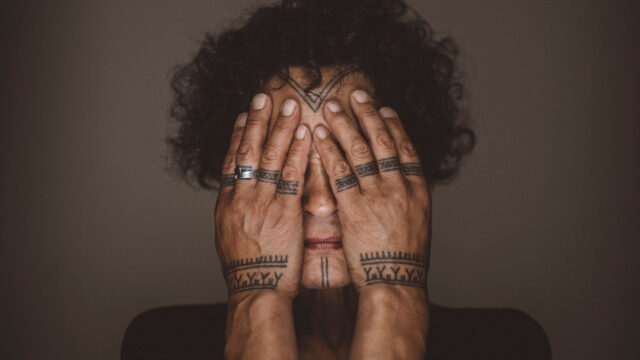
You won’t find many documentaries that were conceived in more unlikely fashion than Lin Alluna’s Twice Colonized (opening CPH:DOX following its world premiere in Sundance, see trailer). The director spotted Greenlandic Inuit lawyer and activist Aaju Peter by chance on the streets near the Tivoli Gardens in Copenhagen.
“It was just a warm summer’s day and I was out walking and suddenly I saw her. I didn’t know who she was or anything about her…”
Alluna was immediately fascinated by Peter. The city was full of tourists in shorts. Peter stood out in the crowd. “Somehow I got the courage to go up to her and invite her out for a cup of coffee.” Fortunately, Peter loved coffee. They’d never met before but Peter was to become the subject of a film which would take seven years to complete. (Twice Colonized is sold by Autlook).
In telling Peter’s story, Alluna chronicles a long and shameful history of colonial oppression of the Inuits, both in Denmark and in Canada. She also shows how seemingly progressive and well-intentioned attitudes have had a disastrous effect on the community. Many feel, for example, that slaughtering seals is barbaric and should be banned. What people don’t notice is how dependent the Inuits remain on seal hunting for their livelihood. When it is taken away, they are plunged even further into poverty.
“The thing is, some of my family is from the Faroe Islands,” Alluna explains why she can approach the highly emotive question of seal culling in an unsentimental way. “I was already aware of how the Inuits were dependent on seal and how seal is actually a sustainable food resource and a resource for clothing.”
By talking to Peter, Alluna was learning about a side of Danish history she had never encountered before. “I don’t know how it is in the UK but the history we were taught in school was that we were not colonisers. We are helpers.”
Discovering the truth was (the director suggests) “a defining moment” in her life. “She [Peter] also revealed hidden secrets about myself like my own prejudice and my own ideas.”
At one stage in the documentary, sold by Autlook, Peter calls the director herself “a coloniser.” It’s a humorous, tongue in cheek remark but one Alluna believes has a ring of truth. “There is no question that I am embedded in the history of colonisation that has had a very negative effect on her life. That is part of why I wanted to make this film – to confront my own country with this history.”
It was part of Peter’s humour to also call the director her “stalker” but the two women are now firm friends.
This is a very intimate portrait of the Inuit lawyer. She is shown campaigning and giving inspirational talks about human rights but Peter’s camera also captures her dancing around her home and in her darker moments, for example when dealing with an abusive boyfriend, or trying to cope with the shocking death of someone very close to her.
“I always wanted to have this flexibility around what to shoot and why to shoot because it is her story,” the director emphasises how her subject helped shape the documentary. “She really needed to have agency.”
Peter insisted that the documentary didn’t just show her triumphs on stage but that it also covered her battles behind the scenes. She watched rough cuts and gave the director notes on what she wanted. Their working method was to try to shoot the rawest, most personal moments – they knew that, if necessary, this material could always be taken out but that if they didn’t film, it would be lost forever.
One very painful theme is the continuing loss of young Inuit lives. Many young people lack opportunities. Suicide numbers are very high.
Some of the most shocking moments in the doc come when Peter reminisces about her childhood and describes the scarcity of food. She and the other kids were sometimes reduced to eating anything they could find that had been thrown away in the garbage.
“I had no idea, absolutely no idea that this was what was going on,” Alluna says of the extreme deprivation experienced by the Inuits.
Peter is a strong, inspirational figure but we see at her at her most vulnerable moments. “That was really a key to me and Aaju’s collaboration. I have also had some really bad relationships in my life. I have also had very weak moments, vulnerable moments, and I still see myself as a strong and capable woman. The two things are not opposites and that was really important for us to show. Otherwise, you create this idea you have to be perfect to make a difference – and that’s not true.”
Twice Colonized is the first co-production between Inuits across borders. Partners behind the film include Anorak from Greenland and Red Marrow from Canada. Fellow Canadian company EyeSteelFilm was also aboard.
Alluna was very aware of her status as a white woman telling an Inuit story. That was why such emphasis was placed on creating an Inuit production team.
Now, the question is how Danish audiences will respond to a film which shows them in an often harsh light.
“I for one can say that Denmark [and the Danes] have not recognised their own history, their own responsibility,” the director says of the widespread ignorance about the country’s colonial legacy.
“Premiering this film in Denmark is going to start a lot of conversations. So many people are not aware of what happened and what is still going on…our goal with the film is to shine a new light on history while also pointing to a better future.” She pauses. “Honestly, I think it is going to be a shock for a lot of Danish people.
”Twice Colonized isn’t intended as a lecture, however. It is supposed to be fun too, reflecting its subject’s energy and humour. “That was so important when we were editing the film. We really wanted for you to feel for her as a human being. We didn’t want her to be a flat hero. We wanted to make as nuanced a portrait as we could,” Alluna ends.