When does democracy end and theocracy begin? That is the question Brazilian director Petra Costa (Olmo and the Seagull, The Edge of Democracy) asks in her latest documentary Apocalypse in the Tropics, world-premiering Out of Competition August 29 in Venice.
The film’s genesis can be traced back to the politically-motivated impeachment of former Brazilian president Dilma Rousseff in 2016. When director Costa entered the Congress building to witness the process of arraignment, what she encountered instead was a group of right-wing evangelicals blessing the seats of the lawmakers, invoking the Lord to guide them in their deliberations.
Petra tells how, later, mere yards from the same building, she observed a public declaration by some of the country’s leading tele evangelists, led by the charismatic Silas Malafaia, that “God should take over the three branches of power,” namely the executive, the legislative and the judiciary. They were disciples of Dominion Theology, a creed which determined that Christians should control all aspects of society, from family life to the economy, all the way to government itself.
In great part, Malafaia and his fellow evangelists succeeded in their task, and planted the very willing Jair Bolsonaro onto the country’s supreme seat of power, the first Brazilian leader to be elected by the Evangelical vote (which had swelled, in percentage terms, from 5% to 30% over the past four decades).
But it was in 2020 that the film took off in earnest. In the midst of the pandemic, the Church was a comfort for many Brazilian devotees, but some evangelists saw Covid as a sign of the devil, and evidence of the imminent Apocalypse. One particular adherent to this belief, a pastor whom Costa and producer Alessandra Orofino had been following, cited Malafaia as his “main inspiration and guide,” the director says in her notes. The team realized, therefore, that they had to engage Malafaia in their film if they were to adequately explain the power dynamics within their country. “Through him we would be able to understand the strange marriage happening before our eyes, between the far right and religious fundamentalism.”
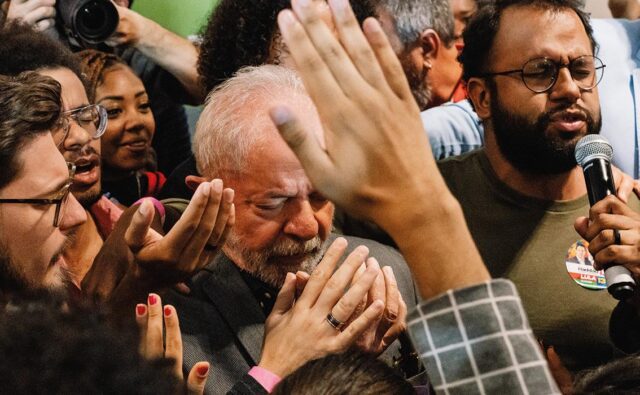
Costa’s subsequent film revolves around three core protagonists; Bolsonaro; the evangelist Malafaia, and Workers Party leader Luiz Inácio Lula da Silva who was jailed for 18 months in 2017/18 on corruption charges, and who regained the presidency in 2022 by the tiniest of margins.
The feature documentary presents Bolsonaro as almost puppet-like in his devotion to the firebrand Malafaia. In one telling sequence, shot on September 7 2021 as Bolsonaro was publicly decrying the actions of the Supreme Court and its criminal investigations into his conduct, we see Malafaia prompting the president, mouthing the very words that the president is proclaiming to the gathered crowds. “We knew they had an intimate political relationship, but as we watched the material, it became so evident the kind of subservience and reverence that Bolsonaro had for Malafaia,” says Costa.
Producer Alessandra Orofino elaborates on the asymmetric bond between the two. “The story that is often told about the relationship between far-right leaders and religious leaders is that the politicians are using the religious leadership…to get elected, [that] they’re using religion to advance their political plans. One of the things that the film reveals is that often it’s actually the opposite. Religious leaders are using politicians to advance their own plans for power and what to do with that power.”
Similarities between the US and Brazil seem evident within the film, even down to the assassination attempts on Bolsonaro and Trump, and the insurrection that saw the major seats of power violently overtaken by supporters of the ousted leaders of the respective countries. But, as Uruguayan scholar Nicolas Iglesias revealed in detailed research, there was a more sinister relationship between the two countries, one in which the US, led in the 1960s and 70s by Nixon and Kissinger, sought to disable Brazil’s socially progressive, grass roots, essentially proletarian Liberation Theology movement which had gained a foothold across Brazil, running counter to capitalist interests.
“Ultimately, the Vatican worked to silence Liberation Theology,” Costa notes. “At the same time, American evangelical organizations, such as The Family, started sending missionaries to Brazil, some of them with the explicit mission of converting Congressmen and other segments of the political elite. When the American televangelist Billy Graham came to Rio de Janeiro, in 1974, for a ‘Crusade’ that lasted several days, his sermons were broadcast to 1,500 municipalities, under direct orders of the [Brazilian] military dictatorship.”
“It was like seeing ourselves in the mirror,” Costa adds to BDE. “Seeing the relationship between Billy Graham and Nixon was exactly like seeing the relationship between Bolsonaro and Malafaia. “It was very uncanny. It’s like, oh my God, our history already happened 40 years ago. The exact same speeches, the exact same discourse is being replayed here 40 years later. And then when Trump is attacked [there is] the inverted mirror. Now…you [the US] are repeating our footsteps.”
Throughout the film, Malafaia is a fascinating, sometimes entertaining presence, but one whose politics are obviously at odds with the filmmakers. How did they manage to persuade him to take part?
“When we realized that he was a character that we really wanted to lean into, we worked with a reporter [Anna Virginia Baloussier] who had already established a relationship with him for a decade and who had interviewed him many times, who had access to him,” answers Orofino. “We worked on that access and that trust over time to the point where at the end he was very comfortable even criticizing Bolsonaro to us, giving us very candid views of his own. But one thing that we should say is that Malafaia was never a reclusive person. He was never someone who didn’t speak to the press or didn’t put himself out there.”
“Even though it definitely took work and effort, he likes the spotlight and he doesn’t really hide what he’s all about,” Costa adds. “He wants to have his voice heard. So that helps a lot. But he was never under any illusions of who we were and what our values were and how those values differed.”
In 2022, Lula had to seek the Evangelical vote in order to tip the electoral balance in his favour. How was this received among his supporters? “The imminent threat was that if Bolsonaro won, he was saying he would increase the number of Supreme Court judges from 11 to 16, which could rapidly change how many of those Supreme Court justices would be pastors. The consequences would be really drastic,” says Costa, who further points out how historical relations between Lula’s Workers Party and the Evangelists have always been complex, if at times cordial.
“I think most people who are secularists or who were rooting for Lula saw [it] as just strategic in the sense that it was a very, very close election, and anything that you could do to minimize losses within any demographic, you kind of did,” adds producer Orofino. “It was damage control at that point, and everyone was desperate…So in that context, it’s understandable that [he] made that choice.”
Apocalypse in the Tropics, produced by Brazilian companies Busca Vida Filmes and Peri Productions, world premieres August 29 in Venice (Out of Competition).